
If telemedicine PHI is exposed, the HIPAA clock starts on the day you discover it. In healthcare, that can mean patient notice within 60 days, HHS notice based on breach size, media notice in some cases, and state-law deadlines that may be shorter, such as 30 days in Florida.
Here’s the short version: I need to figure out whether unsecured PHI was disclosed, document the four-factor risk review, contain the incident without cutting off care, and keep a clean record of every step. That applies whether the issue starts with a video visit platform, remote monitoring device, patient portal, cloud tool, or vendor system. And because telemedicine often runs through outside vendors, business associate duties and BAAs matter from day one.
A few points stand out fast:
- Not every security incident is a reportable HIPAA breach
- A breach review turns on whether unsecured PHI was used or disclosed in a way HIPAA does not allow
- Encrypted data may not trigger notice if the encryption keys were not exposed
- Telemedicine risk is harder to track because PHI may sit in apps, devices, chat logs, recordings, APIs, and cloud backups at the same time
- Covered entities usually lead notice and decision-making, but business associates must report incidents and support the review
- For breaches affecting 500 or more people, HHS notice is due within 60 days of discovery
- For breaches affecting fewer than 500 people, the event usually goes on the annual HHS log
- State laws can set a shorter clock than HIPAA
- Good response means identify, contain, notify, document, and fix the control gap
What separates a compliant response from a weak one? Usually three things: clear ownership, preserved evidence, and on-time reporting. In 2023, healthcare breaches exposed 133,068,542 records. So for me, the takeaway is simple: telemedicine breach response is not just an IT issue; it is a patient-care, legal, and documentation process all at once.
The article below walks through those rules, roles, deadlines, and response steps in plain terms.
HIPAA requirements that apply after a telemedicine device breach
Once a telemedicine device incident looks like a possible breach, HIPAA response is driven by three rules: the Privacy Rule, the Security Rule, and the Breach Notification Rule, as amended by HITECH.[1][4] These rules decide whether the event counts as a breach, who needs to hear about it, and how fast that has to happen.
Privacy, Security, and Breach Notification Rule obligations
The Privacy Rule sets the limits on when PHI can be used or disclosed. If a bad access control setting exposes session data to the wrong provider, the key question is simple: does that unauthorized disclosure need to be reported?[1]
The Security Rule requires safeguards that protect the confidentiality, integrity, and availability of all ePHI.[4][7] In a telemedicine setting, that covers video visits, remote monitoring feeds, and device logs. The goal is to keep them safe from unauthorized access, tampering, and downtime. So even if a ransomware attack doesn’t leak data, it can still trigger Security Rule issues if clinicians get locked out of a telehealth app and availability is disrupted.[4]
The Breach Notification Rule answers the next question: is notice required? That depends on whether the PHI was unsecured. If the data was properly encrypted and the keys were not compromised, notice may not be required. If the data was unencrypted, HIPAA generally treats it as breached unless a documented four-factor risk assessment shows a low probability of compromise.[1][2][3]
Covered entity and business associate responsibilities
Healthcare delivery organizations and telehealth provider groups, as covered entities, have the main job here. They assess the incident, decide whether it is a breach, and handle any required notifications.[1][3] But telemedicine rarely runs on in-house systems alone. Third-party platforms, device makers, and cloud providers are often part of the setup, which means business associates also carry direct duties. They must put Security Rule safeguards in place, report incidents to the covered entity, and help with the investigation.[4][6]
That’s why BAAs matter so much. They need to clearly spell out reporting and cooperation duties. A solid BAA should require the vendor to report any security incident within a set window, giving the covered entity enough time to meet HIPAA’s 60-day deadline.[2][3][8] It should also lay out log-sharing duties, forensic support, and documentation requirements, so the covered entity can finish its risk assessment without getting stuck waiting on the vendor.
Federal and state reporting timelines
These duties turn into fixed federal and state deadlines. Under HIPAA, notice to affected individuals is due within 60 calendar days of discovery.[1][2][5][8] Here’s how the reporting rules change based on breach size.
| Breach Size | Individual Notice | HHS Reporting | Media Notice |
|---|---|---|---|
| 500+ individuals | Within 60 days of discovery[1][2][5][8] | Within 60 days of discovery[1][2][5][8] | Required if 500+ residents of a single state or jurisdiction are affected[3][5] |
| Fewer than 500 individuals | Within 60 days of discovery[1][2] | Annual HHS log[1][2] | Not required under HIPAA |
There’s another piece to watch: state breach notification laws. HIPAA’s 60-day window is the federal outer limit. States can move faster. Florida, for example, requires notice within 30 days.[10][11] If a telemedicine organization serves patients across multiple states, it has to follow the strictest deadline that applies to each patient group.[9][10][11]
Once the deadlines are set, the response has to move in a clear order: identify, contain, notify, and document.
sbb-itb-535baee
A HIPAA-compliant telemedicine breach response process
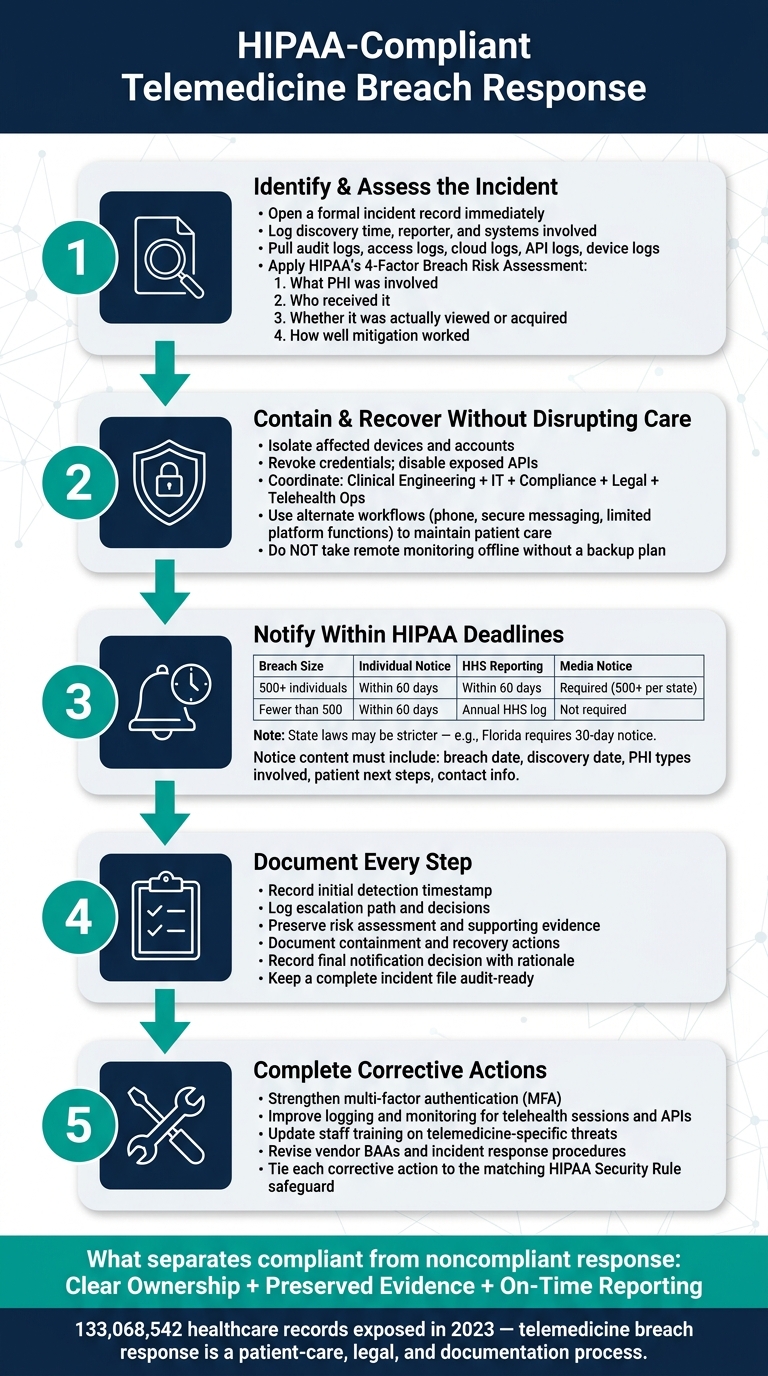
HIPAA Telemedicine Breach Response: 5-Step Compliance Process
When a possible breach shows up, the reporting clock is already ticking. That means you need to move fast from triage into containment and HIPAA review.
Identify and assess the incident
The first few hours matter most. As soon as a potential incident comes to light, open a formal incident record. Log the discovery time, who reported it, which systems were involved, and the early scope.
Then pull the logs that can tell you what happened: audit logs, access logs, cloud logs, API logs, and device logs. The goal is simple: confirm whether PHI was accessed, changed, or exposed.
From there, apply HIPAA’s four-factor breach risk assessment:
- What PHI was involved
- Who received it
- Whether it was actually viewed or acquired
- How well mitigation worked
In a telemedicine setting, this can get very specific, very fast. You may need to review video visit recordings, remote monitoring vitals, mental health notes, or imaging data. You’ll also want to check for signs that data was downloaded or viewed. That detail matters because it shapes both your breach decision and your next move.
Contain and recover without disrupting care
Once you understand the scope, stop digging for a moment and start containing the issue. Isolate affected devices and accounts, revoke credentials, and disable exposed APIs or integrations.
At the same time, don’t shut down care delivery unless you have no other option. If remote monitoring supports patient care, taking it offline without backup can create a second problem. That’s why clinical engineering, IT, compliance, legal, and telehealth operations need to work side by side here.
They should decide:
- What can be isolated safely
- What needs an alternate workflow
- Where temporary controls can keep services running
Those stopgap steps might include phone calls, secure messaging, tighter session authentication, limited platform functions, or extra monitoring until remediation is done. The point is to reduce risk without leaving patients in the lurch.
Notify, document, and complete corrective actions
After containment, documentation and notice prep should happen at the same time. Keep a clean record of the initial detection time, how the incident moved through escalation, the risk assessment and supporting evidence, the containment and recovery steps, and the final notification decision with the reason behind it.
Notifications to affected individuals need to use plain language. They should include the date of the breach, the date of discovery, the types of PHI involved, steps people should take to protect themselves, and contact details for follow-up questions.
If the incident involved telemedicine data, be specific. Name the affected channels, such as recordings, chat, or remote monitoring. Tell patients what they should do next, like securing personal devices and checking visit links before joining sessions.
After notices are sent, finish the corrective action work. Common next steps include strengthening multi-factor authentication, improving logging and monitoring for telehealth sessions and APIs, updating staff training around telemedicine-specific warning signs, and revising vendor agreements and incident response procedures where needed.
Tie each corrective action back to the matching Security Rule safeguard. That makes the record easier to defend and a lot easier to use the next time an incident hits.
Building a telemedicine security program that supports compliance
Breach response shouldn't stop at notice and remediation. It should feed an ongoing telemedicine risk program. The same controls that blunt the impact of a breach also help cut down how often breaches happen.
Map telemedicine risks to HIPAA safeguards
Start with a telemedicine-specific risk inventory. List every platform, remote monitoring portal, connected device, mobile app, and cloud service that creates, receives, maintains, or transmits PHI. Then map each asset to the three HIPAA safeguard categories - administrative (§164.308), physical (§164.310), and technical (§164.312) - and treat those as standing program controls.
| Common Gap | HIPAA Safeguard Category | Practical Control |
|---|---|---|
| Incomplete asset inventory | Administrative | Centralized CMDB with risk ratings and owners |
| Weak or missing MFA | Technical | MFA for all remote and portal access |
| Limited logging and monitoring | Technical | Centralized log collection with role-based alerts |
| Weak patch governance | Administrative / Technical | Vendor SLAs with risk-based patch prioritization |
| Insecure mobile use (BYOD) | Physical / Administrative | MDM enforcement, device encryption, PHI storage restrictions |
| Insufficient workforce training | Administrative | Scenario-based training on secure video visits, phishing, and incident escalation |
Frameworks like NIST CSF and HHS 405(d) Health Industry Cybersecurity Practices (HICP) give technical teams and compliance staff a shared control catalog to work from [12][13][14]. When you map each telemedicine risk to both a HIPAA citation and a framework control ID, audits get less painful. It also gives you a clearer way to explain risk decisions to regulators.
A cross-functional task force that includes IT, compliance, and clinical leadership should review these mappings at least once a year, and any time a new telemedicine service, device, or vendor comes into the picture.
Once that control map is in place, extend it to every vendor and device that touches PHI.
Strengthen vendor and device risk management
Any telemedicine vendor or device partner that creates, receives, maintains, or transmits PHI for you is a business associate under HIPAA. A signed BAA is required. But that document shouldn't be bare-bones. It should spell out encryption standards, access controls, audit logging, patch expectations, breach notification timelines, and what forensic support the vendor will provide during an investigation.
Due diligence also needs to go past the contract. Review independent assessments or certifications such as SOC 2 or HITRUST. For device manufacturers, ask for a software bill of materials (SBOM), documented patch processes, and clear policies for end-of-life devices. Recent telehealth breaches show why vendor inventory, BAA review, and OCR timeline ownership need to be explicit.
Fourth-party exposure matters too. Many telemedicine platforms rely on cloud providers, content delivery networks, and video infrastructure that your organization never contracted with directly. Require vendors to disclose their subprocessors, show due diligence through certifications or penetration testing results, and commit to notifying you about incidents involving those subprocessors when they matter to your risk posture.
Use Censinet to manage telemedicine risk oversight
Centralize the assessment record, supporting evidence, and corrective-action trail so it's ready when OCR or a state regulator reviews the incident. Censinet RiskOps™ supports structured third-party risk assessments of telehealth vendors and device manufacturers using standardized questionnaires aligned with HIPAA requirements. It also keeps BAAs, security assessment results, corrective action records, and incident response documentation in one audit-ready record, so your program shows due diligence as a matter of course instead of forcing teams to piece everything together after the fact.
HIPAA-compliant vs. noncompliant telemedicine breach response
Where compliant programs differ in practice
The biggest split between compliant and noncompliant telemedicine breach response comes down to prep work and paper trail. You can usually spot it fast by looking at how each step was recorded, how fast people moved, and what proof they kept.
| Dimension | HIPAA-Compliant Response | Noncompliant Response |
|---|---|---|
| Governance | Named Privacy Officer, Security Officer, and incident commander with a written response plan | Ad hoc decisions and unclear ownership |
| Breach assessment | Documented four-factor analysis with legal/compliance sign-off | No written rationale |
| Containment | Isolated affected telehealth endpoints, remote devices, and connected accounts; preserved logs before making changes | Rebooted devices or reset passwords without preserving evidence |
| Notification timing | Notices sent within HIPAA deadlines; 500+ breaches require notice within 60 days, and smaller incidents go on the annual HHS log | Delayed by internal approvals; smaller incidents never reported |
| Vendor coordination | BAAs with telemedicine vendors and device partners that specify breach notification timelines and log-sharing duties | Missing or bare-bones BAAs; no third-party risk log review |
| Documentation | Complete incident file with discovery timestamp, device and platform logs, risk assessment, notices, and corrective actions | Incomplete logs, missing risk assessments, and undocumented decisions |
| Corrective actions | Policy updates, device configuration improvements, and staff retraining | Ticket closed after the fix; the same gap remains |
In practice, these gaps usually show up first in three places: who owns the response, whether evidence was preserved, and whether reporting deadlines stayed under control.
Conclusion: Key actions for healthcare leaders
Three priorities stand out.
First, classify telemedicine breaches the right way. Any impermissible acquisition, access, use, or disclosure of unsecured PHI through a telehealth platform, remote monitoring device, or connected app can trigger reporting under HIPAA.
Second, apply the Privacy, Security, and Breach Notification Rules as soon as the incident is detected. The 60-day clock starts at discovery, not when the internal investigation wraps up [1][15].
Third, treat every incident as a documented process, not a one-off fix. That means a risk assessment, containment with evidence preservation, timely notices, and tracked corrective actions. It also means keeping a governance calendar so vendor reviews and control checks happen on a set schedule.
FAQs
What counts as unsecured PHI in telemedicine?
In telemedicine, unsecured PHI means PHI that has not been made unusable, unreadable, or indecipherable to unauthorized people through approved encryption or destruction.
For breach response, any impermissible acquisition, access, use, or disclosure of unsecured PHI is presumed to be a breach. The only exception is when a documented four-factor risk assessment shows a low probability that the PHI was compromised.
When does a telemedicine incident become a reportable breach?
Under HIPAA, any use or disclosure of unsecured protected health information without permission is generally treated as a reportable breach.
There are only a few exceptions. The incident may not count as a breach if the data was made unusable, unreadable, or indecipherable through approved encryption or destruction. It may also be exempt if a documented four-factor risk assessment shows a low probability of compromise. Censinet RiskOps™ can help support these assessments and the reporting that goes with them.
How should vendors support HIPAA breach response?
Vendors should keep signed Business Associate Agreements (BAAs) in place. Those agreements need to spell out each party’s role, day-to-day duties, and the process for breach notices.
If a possible breach is found, the vendor must notify the covered entity without unreasonable delay and no later than 60 days. The notice should include enough detail to support the investigation and help meet legal notice rules. Vendors also need to work with forensic teams and support the required documentation.
