
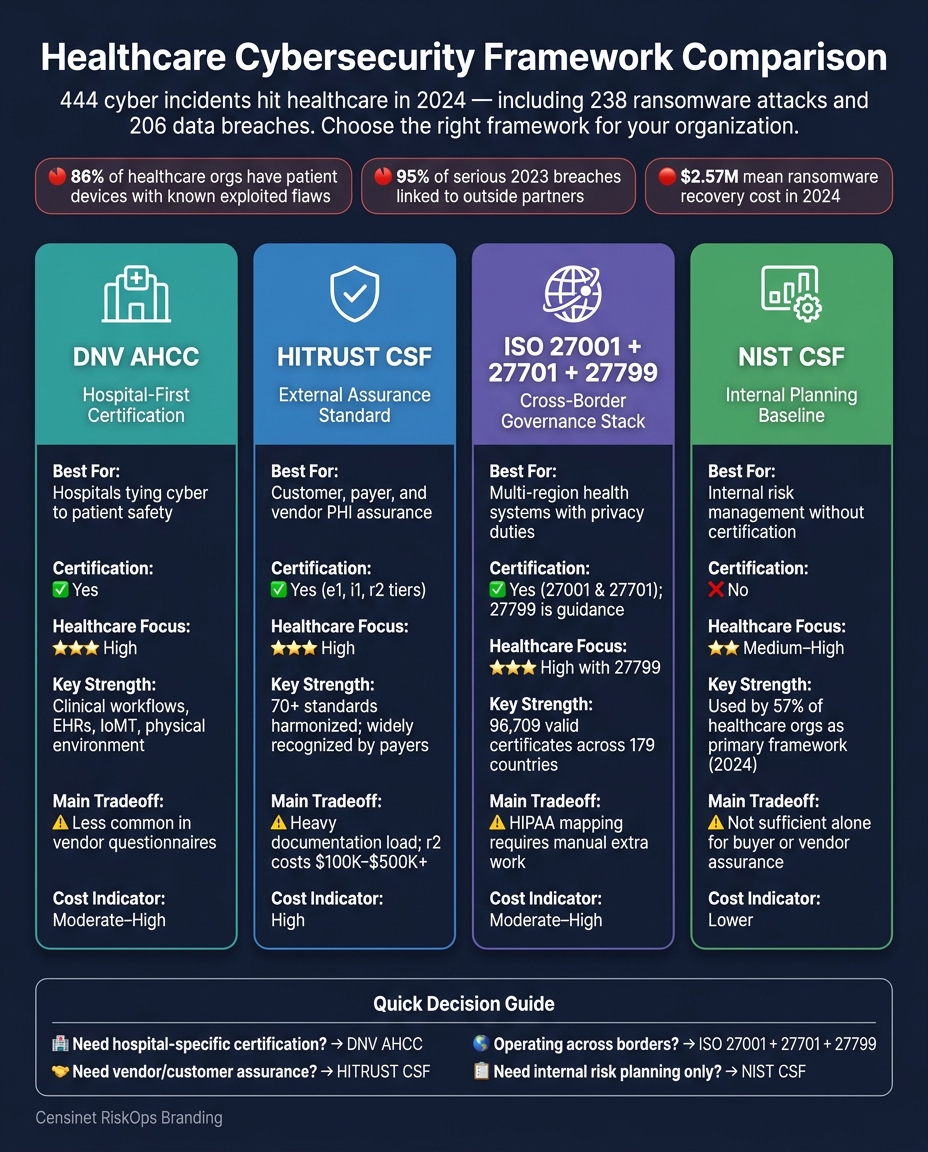
Healthcare had 444 cyber incidents in 2024, including 238 ransomware threats and 206 data breaches. If I were picking a framework today, I’d keep it simple: DNV AHCC for hospital-focused certification, HITRUST for outside assurance, ISO 27001 + 27701 + 27799 for multi-country governance, and NIST CSF for internal risk planning.
Here’s the short version:
- DNV AHCC is built for hospitals and ties cyber controls to patient safety, records, care workflows, buildings, and connected devices.
- HITRUST CSF is often the choice when buyers, partners, or vendors want a named certification for PHI controls.
- ISO 27001 + 27701 + 27799 fits health systems that need one security and privacy program across regions and data-sharing models.
- NIST CSF is not a certification, but it is a common framework for gap reviews, target-state planning, and cyber maturity work.
A few numbers make the issue clear:
- 86% of healthcare groups have patient devices with known exploited flaws
- 95% of the most serious 2023 health-sector breaches were linked to outside partners
- Mean ransomware recovery cost reached $2.57 million in 2024
- 57% of surveyed healthcare groups said NIST CSF was their main framework in 2024
If you want the fastest decision path, I’d use this:
- Pick DNV AHCC if your main goal is hospital-specific certification
- Pick HITRUST if your main goal is customer and vendor assurance
- Pick ISO if your main goal is cross-border security and privacy management
- Pick NIST CSF if your main goal is internal planning without certification
Healthcare Cybersecurity Frameworks Compared: DNV AHCC vs HITRUST vs ISO vs NIST CSF
Quick Comparison
| Option | Best for | Certification | Healthcare focus | Main tradeoff |
|---|---|---|---|---|
| DNV AHCC | Hospitals that want cyber tied to patient care | Yes | High | Less common in vendor requests |
| HITRUST CSF | External assurance and PHI control proof | Yes | High | Heavy audit and documentation load |
| ISO 27001 + 27701 + 27799 | Multi-region governance and privacy | Yes, for 27001/27701 | High with 27799 guidance | HIPAA mapping takes extra work |
| NIST CSF | Internal risk management and planning | No | Medium to high | Not enough by itself for buyer assurance |
So the choice is not about one “best” framework. It’s about fit. I’d read DNV AHCC as the hospital-first option, HITRUST as the assurance-heavy option, ISO as the cross-border option, and NIST CSF as the planning baseline.
sbb-itb-535baee
1. DNV Advanced Healthcare Cybersecurity Certification (AHCC)
DNV presents AHCC as a cybersecurity certification built specifically for hospitals. It goes beyond generic IT controls and looks at the parts of healthcare that can’t afford downtime: EHRs, medical staff workflows, physical infrastructure, and IoMT. The idea is simple: connect cyber controls directly to patient safety and care disruption risks.[7][8][10]
Healthcare Fit
AHCC lines up with how hospitals actually work. It maps to staffing, patient rights, medical records, and physical environment controls across buildings, cloud storage, data centers, mobile devices, hardware, and software.[7]
That alignment matters. In a hospital, cybersecurity isn’t just about servers and logins. It touches patient intake, chart access, device use on the floor, and even the spaces where care happens. AHCC reflects that day-to-day reality instead of treating healthcare like any other industry.
It also carries more weight than a self-check exercise because compliance is verified through a formal audit cycle, not self-attestation.
Certifiability
AHCC includes an initial survey and periodic follow-up assessments to confirm that compliance continues over time.[7][9] In plain English, hospitals don’t just pass once and move on. They have to keep showing the work.
Common evidence includes:
That makes AHCC a certifiable program with documented proof behind it, not just a set of recommendations.
Privacy Alignment
AHCC builds privacy into the cybersecurity program itself. Hospitals must disclose patient rights before care starts or ends, and medical record controls govern access, retention, and disclosure of PHI.[7] It also connects privacy operations to HIPAA and HITECH requirements.[8][10]
That link is a big deal in healthcare. Security and privacy often get talked about as separate tracks, but in practice they’re tangled together. If a hospital can’t control who sees a record, how long it’s kept, or when it’s shared, the problem isn’t only technical. It affects patient trust and legal duties too.
Implementation Depth
AHCC asks hospitals to do more than write policies. They need recurring risk assessments tied to clinical operations, incident drills built into emergency planning, and ongoing staff training that supports a culture of cybersecurity and safe care delivery.[7][8][10] AHCC also addresses AI and automation risk.[7]
That gives the program more depth on the ground. It pushes hospitals to test plans, train people, and connect cyber prep to clinical response. For organizations dealing with connected devices, busy care teams, and round-the-clock operations, that kind of day-to-day follow-through matters.
Next, compare AHCC with HITRUST's broader control framework.
2. HITRUST CSF
Compared with AHCC, HITRUST is the broader, more standardized certification used across hospitals and vendors. AHCC is more hospital-specific. HITRUST, by contrast, serves as the larger control framework for both hospitals and the companies that support them.
That distinction matters. HITRUST spells out what controls must be in place, how those controls should be documented, and how testing will be done. So it works well for organizations that need to show compliance to outside stakeholders, not just handle risk inside the business.
Healthcare Fit
HITRUST harmonizes 70+ standards, regulations, and industry best practices into one control set across 19 domains.[21][22] It is built around U.S. healthcare rules, workflows, and risk profiles. That includes areas like access control, endpoint protection, and mobile device security, which line up closely with the messy, high-stakes nature of healthcare IT.
Certifiability
HITRUST offers e1, i1, and r2. In practice, r2 is the option many organizations look to when they want stronger contractual assurance.
Premise Health earned HITRUST r2 for the eighth consecutive year in January 2025, which shows the certification can be renewed over time.[18]
This carries weight during procurement. Covered entities may require HITRUST r2 from cloud EHR vendors, patient-portal providers, and analytics platforms before signing a contract.[14][15][16] Instead of answering the same customer questionnaires again and again, a single HITRUST certification can help cut that burden down.
Privacy Alignment
HITRUST integrates privacy requirements directly into its control specifications, covering HIPAA-compliant vendor risk management, CCPA, and GDPR within the same assessment structure.[12][13] That makes life easier for teams that don't want privacy sitting in one lane and security in another.
Platforms like Censinet RiskOps™ can use HITRUST certification status and control maturity scores as inputs in vendor risk models.[15][16] For procurement teams, that creates a more structured way to review privacy posture alongside security controls.
Implementation Depth
HITRUST uses five maturity levels: policy, procedure, implemented, measured, and managed.[11][15][17] In plain English, this means an organization can't stop at writing things down. It has to show that controls are in use, tracked, and improved over time.
One documented version includes 156 control specifications across 49 objectives and 14 categories.[12][13] And the lift can be expensive: r2 certification typically costs $100,000-$500,000+ depending on scope and size.[20]
Next, compare HITRUST with ISO's global security and privacy certifications.
3. ISO/IEC 27001 with ISO/IEC 27701 and ISO 27799
Where HITRUST is built for healthcare and often shaped by procurement needs, ISO is usually the stronger option for cross-border governance. ISO/IEC 27001 is a risk-based ISMS for organizations that need one security program across hospitals, clinics, and countries. Compared with DNV AHCC, ISO gives up some healthcare-specific detail in exchange for broader international reach.[26][28]
These standards work best as a stack. ISO/IEC 27001 is the base layer. It sets the ISMS structure. ISO/IEC 27701 adds privacy by extending that system into a Privacy Information Management System (PIMS) for personal data governance. ISO 27799 adds the healthcare layer, applying ISO/IEC 27002 controls to PHI, clinical workflows, EHRs, imaging systems, and medical devices.[29][3][1][25] That broader scope is useful, but it also means less direct alignment with day-to-day hospital operations.
Healthcare Fit
ISO 27799 is what makes this stack especially useful in clinical environments. It covers health information in paper, electronic, audio, video, fax, and network transmission formats.[2] That matters because health data rarely lives in just one place.
It also deals with issues hospitals run into all the time: emergency break-glass access to patient records, matching patients across systems, and handling highly sensitive records such as mental health, genetic, and HIV/AIDS data.[2][23][6] For U.S. providers running multi-hospital systems, telehealth platforms, or mobile apps, ISO 27799 helps shape the ISMS around healthcare work instead of forcing care teams to work around the framework.[24][6]
Certifiability
ISO/IEC 27001 is widely certifiable. ISO Survey 2024 counted 96,709 valid certificates across 179,877 sites worldwide.[26][28][30][31][32]
ISO/IEC 27701 can extend that certification. ISO 27799, by contrast, is guidance rather than a standalone certificate. In practice, auditors usually review it as part of an ISO/IEC 27001 audit, not as its own certification path.[3][2][23][25]
Privacy Alignment
ISO/IEC 27701 can be mapped to HIPAA requirements and gives U.S. healthcare organizations a structured, auditable way to document privacy controls for PHI across the enterprise.[29] That’s a big deal if privacy work is spread across legal, compliance, security, and IT teams.
When paired with ISO 27799, the stack covers both security and privacy duties for health data in one integrated program. Teams can use it to manage cross-border data sharing, research data use, and patient portal activity under one framework, instead of handling HIPAA in one track and international privacy duties in another.[2][24][6][25][27][29]
Implementation Depth
Putting this in place takes real documentation work. Organizations need:
- An ISMS/PIMS scope and audit documentation
- PHI and privacy risk registers
- Asset inventories
- Data-flow maps
- Audit evidence[25][26][28]
Censinet RiskOps™ can support ISO-aligned vendor risk assessments and cybersecurity benchmarking for PHI, clinical applications, and medical devices.
Organizations that want less formal certification and more flexibility often compare this stack with NIST CSF next.
4. NIST Cybersecurity Framework (CSF)
NIST CSF is voluntary and non-certifiable. In plain English, that means it works best as a flexible risk-management framework for the enterprise, not as a badge you can earn. That’s why it often serves as the planning baseline when teams compare it with DNV AHCC’s audit-driven, healthcare-focused model. In the 2024 Healthcare Cybersecurity Benchmarking Study by KLAS and Health-ISAC, 57% of surveyed organizations said it was their primary framework.[19]
Healthcare Fit
Compared with certifiable programs, NIST CSF is the most flexible baseline for healthcare. A hospital or health system can use it across EHRs, imaging, lab systems, medical devices, remote access, and third-party connections. That range matters because healthcare tech stacks are rarely neat or simple.
The HPH Sector Cybersecurity Framework Implementation Guide, developed by HHS, CISA, and the Health Sector Coordinating Council (HSCC), helps bridge the gap between the framework and day-to-day healthcare use. It translates CSF into guidance for both clinical and business settings.[4][38][40]
Certifiability
NIST CSF does not produce a certificate. Organizations can still show alignment through internal reviews or third-party assessments, but that is not the same thing as formal certification. In most cases, outside assurance comes from a certifiable program that sits on top of CSF.[34][36]
Privacy Alignment
NIST maps the HIPAA Security Rule to CSF subcategories and SP 800-53 controls. For covered entities, that creates a direct line between framework activities and regulatory duties. When paired with the NIST Privacy Framework, CSF also helps teams manage privacy risk alongside security work.[33][35][39]
Implementation Depth
CSF uses current and target profiles to show where an organization stands today and where it wants to go next. That setup is useful for gap analysis and planning, especially in large health systems where progress rarely happens all at once.
CSF 2.0 adds a Govern function and implementation examples. Even so, teams still need to translate framework outcomes into specific controls, tests, and metrics. That last step is where the real work starts.[4][37][41][42]
That makes CSF the planning layer. The next section looks at where it does its best work and where certifiable options have the edge.
Strengths and Tradeoffs of Each Option
Each option fits a different job: clinical detail, outside assurance, global governance, or internal risk management. For hospitals trying to protect PHI while also meeting outside assurance demands, those differences have direct day-to-day effects.
The table below shows where each option stands out and what it asks from the organization in return.
| Framework | Practical Benefits | Resource Demands | Audit Complexity | Patient Data & Clinical Fit |
|---|---|---|---|---|
| DNV AHCC | Healthcare-native; ties cybersecurity to patient rights, medical record services, the physical environment, and clinical workflows [43] | Moderate to high; spans IT and operational/clinical domains [43] | Moderate to high; requires cross-department evidence gathering and remediation [43] | Strong - built specifically for clinical operations and patient data protection [43] |
| HITRUST CSF | Broad control set; widely recognized by payers, health systems, and cloud service providers for PHI assurance [44] | High; requires extensive documentation, staffing, and remediation across the enterprise [44] | High; evidence-heavy, documentation-driven process with third-party assessors [44] | Strong - integrates HIPAA, HITECH, and other U.S. regulations into a single control set [44] |
| ISO/IEC 27001 + 27701 + 27799 | Globally recognized management system with healthcare-specific control guidance for PHI and health informatics [3][5][6] | Moderate to high; requires a full ISMS lifecycle and surveillance audits [3][6] | Moderate; certification is to ISO 27001, with ISO 27799 adding healthcare depth as guidance [5][6] | Strong for PHI governance and multi-region environments, but requires manual HIPAA mapping [3][5][6] |
| NIST CSF | Flexible, scalable, and widely used - 57% of healthcare organizations used it as their primary framework in 2024 [19] | Lower than certification-heavy options; supports phased maturity building [4][45] | Low; no formal certification scheme [4][45] | Good as a foundation, but weaker as a standalone assurance mechanism for clinical and vendor trust [4][19] |
Those tradeoffs matter in practice.
DNV AHCC is the most clinically specific choice. That can be a big plus for hospitals because it lines up closely with care delivery. But there’s a catch: it isn’t named as often in vendor questionnaires, which teams can automatically answer using existing documentation, so it may not check the box when a partner asks for HITRUST or ISO 27001 by name. [43][44]
HITRUST gives hospitals the strongest outside-facing assurance for PHI. If the goal is to show payers, partners, and vendors that controls are in place, HITRUST carries weight. The downside is the workload. It is the most documentation-heavy path in the group. [44]
ISO/IEC 27001 with ISO 27701 and ISO 27799 gives organizations a strict, auditable route, which can make a lot of sense for teams working across more than one region. It brings healthcare guidance into a global management-system model. Still, HIPAA alignment does not happen on its own, so teams should plan for manual mapping work. [3][2][1]
NIST CSF fits best as an internal starting point for phased maturity building. It’s flexible and easier to grow into than certification-based options. But if a hospital needs certifiable assurance for buyers, partners, or vendors, NIST CSF by itself usually won’t be enough. These differences shape the final decision between clinical fit, outside assurance, and room to operate.
Conclusion
There’s no one-size-fits-all framework for hospitals. The right pick comes down to what you need most: clinical-focused assurance, outside validation, global governance, or an internal way to manage risk. DNV AHCC stands out when a hospital wants certification tied straight to patient safety and day-to-day clinical operations. Put simply, these four options fall into three main jobs: certification, governance, or internal maturity building.
Use this quick decision guide to match the framework to the problem in front of you.
| If your priority is… | Consider… |
|---|---|
| Clinical cyber maturity and patient safety | DNV AHCC - designed for hospitals and focused on EHRs, IoMT, and clinical workflows [8][7] |
| HIPAA-aligned controls and external assurance | HITRUST CSF - widely recognized, audit-friendly, and maps well to HIPAA and other U.S. security requirements [21][46] |
| International operations and cross-border privacy | ISO/IEC 27001 + 27701 + 27799 - globally recognized and well suited to multi-jurisdiction data flows and privacy management |
| Internal cyber maturity without certification | NIST CSF - flexible, scalable, and a practical starting point |
For many community and regional hospitals, DNV AHCC + NIST CSF is a practical mix of certification and day-to-day risk management. Larger health systems with heavy vendor-assurance demands may also add HITRUST CSF. If your organization has cross-border privacy duties, ISO/IEC 27001 + 27701 + 27799 will usually make more sense. One catch: HIPAA alignment still takes manual mapping, so it’s smart to set aside time and staff for that work.
Keeping any of these programs running takes steady evidence collection, vendor risk tracking, including common third-party risk assessment questions, and audit readiness. Censinet RiskOps™ supports third-party and enterprise risk management across patient data, PHI, clinical applications, medical devices, and supply chains.
FAQs
Is DNV AHCC enough on its own?
No. DNV AHCC certification gives you a point-in-time snapshot of security controls, but it doesn't guarantee full compliance or wipe out risk.
Healthcare organizations still need to maintain their own technical, administrative, and physical safeguards for PHI. If you lean on certification alone, it's easy to miss gaps tied to ongoing risks, supply chain weak spots, and HIPAA-specific requirements.
How hard is DNV AHCC to implement?
Implementing DNV AHCC is a major lift. It takes time, staff effort, and day-to-day follow-through to meet detailed requirements and keep documentation accurate and complete.
Most organizations need prep work before the formal assessment starts. That often includes readiness reviews, gap analyses, and fixing technical control issues that show up early. Tools like Censinet RiskOps can help by putting documentation in one place and making ongoing oversight easier.
Can hospitals use more than one framework?
Yes. Hospitals and healthcare groups often use more than one cybersecurity framework to handle risk and compliance.
For example, a health system might use the NIST Cybersecurity Framework for planning and board-level discussions, while relying on NIST 800-53 or ISO/IEC 27001 for day-to-day technical work.
That setup helps teams deal with HIPAA, PCI DSS, and state-specific rules at the same time. It can also cut down on duplicate assessment work, which saves time and makes audits a lot less painful.
