
If patient data leaves the U.S., I don’t treat it like a normal vendor review. I start with four checks: where the data goes, which laws apply, whether the vendor’s controls match the risk, and how I’ll review the transfer over time. That matters because in one 2023 review, business associate attacks were tied to 58 of 77.3 million people affected by healthcare breaches, and healthcare made up 41.2% of third-party breaches in one dataset.
Here’s the short version:
- I map every transfer path for PHI and ePHI
- I confirm HIPAA, the BAA, and any foreign transfer rules
- I check country-level legal risk, subprocessor use, and sanctions exposure
- I verify controls like encryption, key control, segmentation, and limited admin access
- I score residual risk before I approve, delay, or reject the vendor
- I keep a live register and review again when vendors, countries, or systems change
This article lays out a four-step way to review cross-border vendor risk without relying on contract language alone.
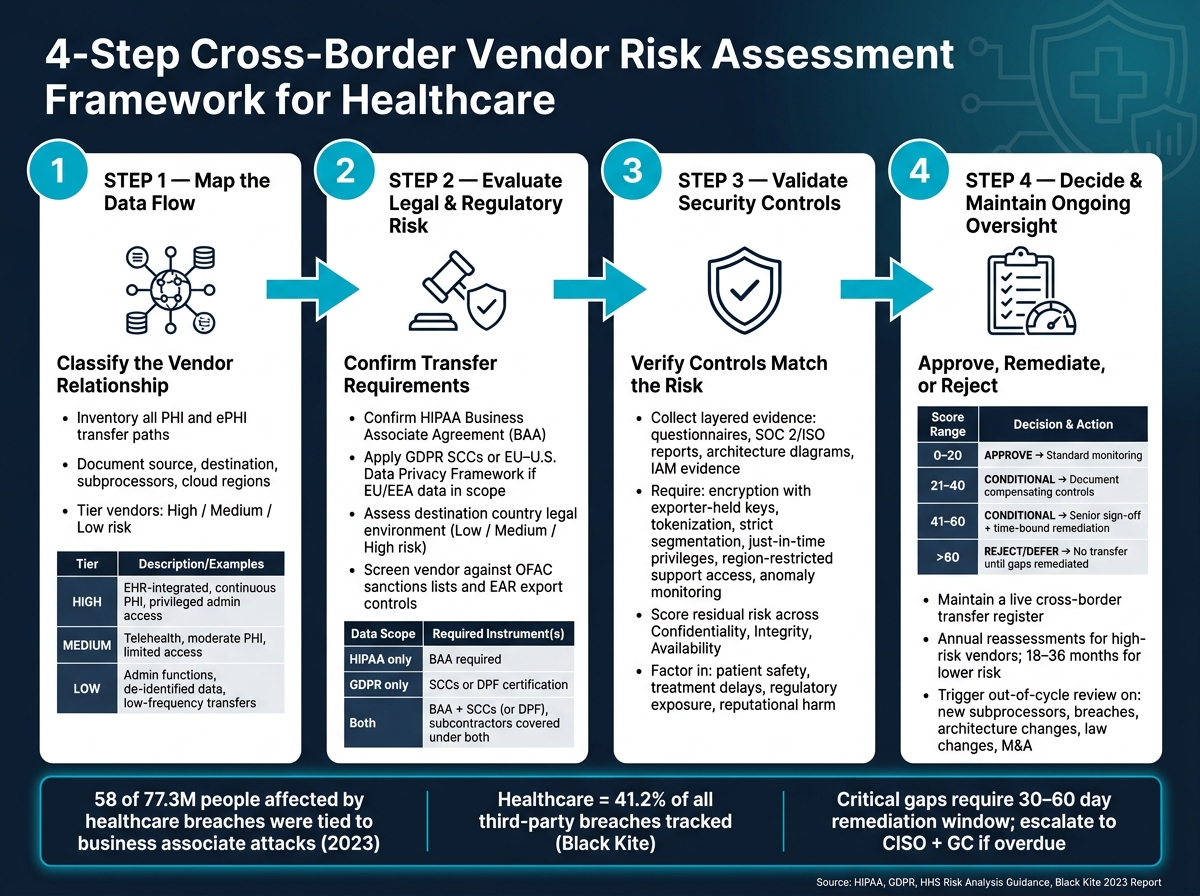
4-Step Cross-Border Vendor Risk Assessment Framework for Healthcare
Episode 16 - Manage territorial scope and cross-border implications across differing privacy laws
sbb-itb-535baee
Step 1: Map the data flow and classify the vendor relationship
Start with a full data-flow map before you look at legal or security risk. A lot of cross-border reviews go off track for a simple reason: the team is working from an incomplete picture of the transfer. If you don’t know where data goes or who can get to it, every legal and security call that comes next rests on guesswork. Use this map to guide the legal review in Step 2.
Document what data moves, where it goes, and who can access it
Build an end-to-end inventory of the vendor relationship first. For each transfer, document the data categories involved. Patient demographics, diagnosis codes, lab results, imaging files, insurance information, payment data, and device-generated data don’t carry the same level of risk. Clearly separate PHI and ePHI from ordinary business data, and flag any highly sensitive data that could add privacy or legal risk when it moves across borders. Map data at the field or dataset level, not just the application level. One vendor platform can handle low-risk administrative records and high-risk clinical data at the same time.
Record the source system, transmission method, destination systems, cloud regions, backup and disaster recovery sites, subprocessors, and support-access locations. Also note whether the transfer is continuous, batch-based, or event-triggered, such as during claims processing or telehealth visits. A vendor might store data in one country while support access or incident troubleshooting happens from another jurisdiction. That still creates cross-border transfer risk. Capture whether access is limited to named personnel, whether it is time-bound or permanent, and whether support teams work from a different jurisdiction than the data itself. [4][6][7]
Keep a centralized cross-border transfer register with the vendor name, business owner, data categories, source and destination jurisdictions, subprocessors, storage and access locations, transfer frequency, and links to the data-flow diagram and BAA. Pair that register with a visual data-flow diagram. It helps reviewers spot each hop in the chain and cuts the odds that hidden subprocessors or backup setups get missed. [4][5][7]
Tier vendors by criticality and data sensitivity
Tier vendors based on the impact of a failure and the sensitivity of the data they touch. A vendor that hosts a patient portal with continuous PHI access and EHR integration belongs in a very different risk bucket than one handling de-identified analytics on a limited batch schedule, even if both operate in the same country. This kind of tiering also brings consistency to procurement and security reviews, instead of leaving teams to make one-off judgment calls. [1][2][3]
| Risk Tier | Typical Vendor Profile |
|---|---|
| High | EHR-integrated, direct patient care, privileged admin access, continuous PHI transfer |
| Medium | Telehealth, moderate PHI volume, limited privileged access |
| Low | Administrative functions, de-identified or non-PHI data, low-frequency transfers |
Use the tier to decide how deep the review should go in Steps 2 and 3.
Step 2: Evaluate Legal and Regulatory Transfer Risk
Use the data-flow map and vendor tier from Step 1 to figure out which laws, contract duties, and transfer rules apply to each cross-border path. HIPAA is only part of the picture. The map should show which transfers need HIPAA review, which need international transfer controls, and which need both. That legal read shapes the next move: a vendor either moves on to security validation, goes into remediation, or gets rejected.
Confirm HIPAA, BAA, and International Transfer Requirements
First, confirm whether the vendor is a HIPAA business associate. That means the vendor creates, receives, maintains, or transmits PHI on your behalf. If it does, you need a written Business Associate Agreement before any PHI is transferred. That agreement must cover permitted uses and disclosures, required safeguards, and breach reporting duties.[8][12]
If offshore subcontractors touch PHI, require written flow-down terms and get a list of every country where they operate.[9]
If EU or EEA patient data is in scope, GDPR may also apply. In that case, a BAA alone won't do the job. You also need a lawful transfer mechanism. One option is the European Commission's Standard Contractual Clauses (SCCs), issued June 4, 2021, for transfers to the U.S.[10][11] If the vendor has a current EU–U.S. Data Privacy Framework (DPF) certification, you may rely on that adequacy decision instead. But don't take it at face value. Check that the certification is active and that it covers the data types and processing purposes involved.
| Legal Regime | Core Document | Key Focus |
|---|---|---|
| HIPAA | Business Associate Agreement | Permitted PHI use, safeguards, breach reporting |
| GDPR (EU/EEA patient data) | SCCs or DPF certification | Equivalent protection in the destination country |
| Both apply | BAA + SCCs (or DPF) | Combined obligations; subcontractors covered under both |
Assess the Legal Environment in the Destination Country
A BAA or SCC is not the finish line. You still need to look at whether local law or government access practices undercut those protections.[21]
Rate each destination country as low, medium, or high risk based on a few plain factors: the strength of its data protection rules, court independence, whether people have usable legal remedies, and how transparent the government is about access requests.[18][20] If a country lands in the higher-risk bucket, contract language by itself usually isn't enough. In those cases, strong encryption and tight key management may be needed.[5][19]
Also check for data localization rules or health-sector requirements that limit how a vendor can store or move PHI after it reaches that country. This is where things can get tricky fast. A transfer may look fine on paper, then run into local storage limits or health-data rules once the data arrives.
After the local-law review, screen for sanctions and export-control issues. Some of these issues don't just add risk - they can stop approval cold.
Screen for Sanctions and Export Control Exposure
Screen the vendor, its parent company, and its beneficial owners against OFAC and other relevant sanctions lists before approval.[15][16]
Then check whether the transfer involves controlled technology under EAR. This can include advanced imaging, AI diagnostics, remote surgery, and encryption.[13][14] If any of those are in play, bring in export control counsel before approving the transfer. Document the classification finding in the vendor's risk profile so Step 3 has a clear legal starting point.[15][17]
Use the legal-risk result to define the controls Step 3 must verify.
Step 3: Validate the vendor's security controls for cross-border use
Use the legal findings from Step 2 to check whether the vendor's controls can handle the risks tied to the destination country. If the security setup is weak, paperwork by itself won't make the transfer safe.
Collect evidence on security, privacy, and operational resilience
Don't stop at a questionnaire. Put together a layered evidence package so you can check that the controls both exist and work in day-to-day use. That review should line up with the exact countries, subprocessors, and access paths you already mapped in Step 1.
Ask for the vendor's security questionnaire, independent assurance report, architecture diagrams, IAM and key-management evidence, backup and disaster recovery plans, incident-response policy, breach history, and subprocessor list with locations and further transfer controls.
Also confirm that the vendor can enforce retention and deletion for international datasets. It helps to know whether resilience controls change by country or facility, because a vendor might look strong in one region and rely on weaker recovery arrangements somewhere else. A vendor can also have a polished questionnaire and still show a pattern of incidents. That's a red flag. The goal is to see whether the controls hold up in practice, not just on paper.
Treat missing evidence as a cross-border threat that needs to be fixed before approval.
Identify cross-border threats and required supplementary controls
Cross-border transfers bring risks that don't show up as often in domestic hosting: interception in transit, offshore insider access, ransomware spread, weak regional segregation, poor key management, and government access in the destination country.[5][7][23][27][28] These are the technical results of the destination-country and access risks found in Step 2, especially when local law or government access practices can weaken contract terms.
Risk goes up when administrators, support engineers, or subprocessors across multiple countries can reach production data without strong segmentation or approval controls.
Guidance on international transfers under GDPR says that, in countries without adequate protection, transfer should not go forward unless the data are strongly encrypted or pseudonymized so they cannot be read or reidentified in the recipient country - including by the intended recipient - without exporter-held keys or additional data.[5][22][7][23][27][28]
Use those threat paths to set the supplementary controls the vendor must meet.
Require:
- encryption with exporter-held keys
- tokenization or pseudonymization
- strict environment segmentation
- tightly limited admin access
- just-in-time privileges
- region-restricted support access
- separate development and production environments
- customer-controlled key rotation
- anomaly monitoring
- minimum-necessary data sharing[24][25][26][28]
Score residual risk using a standardized model
Score residual risk only after you compare the evidence against the transfer-path threats and the required controls. Use a model that looks at confidentiality, integrity, and availability on their own, then combines them with likelihood and business impact after controls are in place.
For healthcare data, the impact score should directly account for patient safety, treatment delays, clinical workflow disruption, regulatory exposure, and reputational harm. Start with an inherent risk score. Then apply the effect of both baseline and supplementary controls. Document residual risk with clear assumptions, including whether data are encrypted, where keys are stored, and which jurisdictions can access production systems. The score should reflect both the legal exposure found in Step 2 and any control gaps found in Step 3.
The final residual risk score should be clear enough for decision-makers to compare vendors in a consistent way and use directly in the approval or escalation decision in Step 4.
Step 4: Make the risk decision and set up ongoing oversight
Once you have the residual risk score from Step 3, you can make a formal decision and keep that decision up to date as things change.
Set approval thresholds, remediation deadlines, and escalation paths
Set your approval bands before reviewing any vendor, not after. Use this decision matrix:
| Residual Risk Score | Decision | Required Action |
|---|---|---|
| 0–20 | Approve | Standard monitoring |
| 21–40 | Conditional approval | Document compensating controls |
| 41–60 | Conditional approval | Senior sign-off; time-bound remediation plan |
| >60 | Reject or defer | No transfer until critical gaps are remediated |
Only require the controls that were already validated in Step 3.
After the decision is made, record the conditions and deadlines in the same register used to track the transfer.
For high-risk vendors, security shouldn't make the call alone. High-risk transfers need cross-functional sign-off, not IT-only approval. Legal confirms that the transfer mechanism is valid and that the destination country's legal setting is acceptable. Privacy and compliance verify HIPAA, BAA, and any state law duties that apply. Clinical leadership should weigh the patient safety impact too. If a disruption or compromise would create an unacceptable care risk, that needs to be part of the decision. Document each stakeholder's input before the decision is finalized.
For any conditional approval, assign a named owner to every open finding, both on your side and on the vendor's side. Critical gaps, like missing encryption or unresolved high-severity vulnerabilities, should have a 30–60 day remediation window. Medium findings can have 90–180 days, but interim safeguards should stay in place during that period. If a critical gap is more than 30 days overdue, escalate it to the CISO and General Counsel. If the issue still isn't fixed after the deadline, suspend the transfer or use the contract remedies available.
Sometimes a control can't be put in place right away. A vendor may not be able to segregate EU and U.S. PHI, for example. In that case, document a formal risk acceptance statement. That record should list the exact gap, the related threat, the compensating controls in place, the business reason, the approving authority, and a firm review date. If a gap can't be fixed before go-live, this step isn't optional.
Maintain a cross-border transfer register and reassessment schedule
After approval, the register becomes the live record for monitoring and reassessment. It ties the data-flow map from Step 1 to the residual risk score from Step 3 in one traceable oversight record. At a minimum, each entry should include the residual risk score and decision, the approving authority, and any material changes or incidents since the last review.
This register isn't just paperwork. It gives you a working record you can use when things get messy. During a regulatory inquiry, it shows which vendors receive PHI outside the United States, what safeguards are in place, and how each decision was made. During an internal audit, it helps teams sample and test control effectiveness across vendors with similar risk profiles. The U.S. GAO has recommended that organizations require regular vendor reports describing compliance efforts, privacy violations, and downstream vendors[29] - a live register makes that oversight possible in day-to-day practice, not just on paper.
Set annual reassessments for high-risk vendors and reviews every 18–36 months for lower-risk relationships. But the calendar can't be your only trigger. Reassess out of cycle if:
- A vendor adds new subprocessors or moves hosting to another country
- A security incident or breach affects the vendor's environment
- The vendor makes major architectural changes
- Privacy or surveillance laws change in the destination country
- The vendor goes through a merger or acquisition
HHS risk analysis guidance calls for continuous risk analysis so that security measures can be updated "as needed"[30]. For high-risk cross-border relationships, a once-a-year review by itself won't meet that bar.
Censinet RiskOps™ can serve as a dynamic transfer register for healthcare organizations. It can update entries based on assessment data, vendor attestations, and workflow outcomes, and trigger alerts when vendors report new subprocessors, when questionnaire responses change, or when external intelligence points to a shift in jurisdictional risk. Keep the register current so approvals, changes, and reassessments remain traceable.
Conclusion: A practical framework for safer international healthcare data sharing
The safest approach is the same one used throughout this guide: map the transfer, test the legal basis, verify controls, and reassess on a regular basis.
That turns the four-step review into a process teams can repeat instead of a one-off exercise. And that matters, because cross-border vendor risk is never just a legal issue. When PHI, clinical systems, or patient-facing services move outside the United States, you're dealing with legal, privacy, and cybersecurity risk at the same time.
The practical path is pretty clear:
- Map the data flow
- Confirm legal permission under HIPAA and any foreign transfer rules that apply
- Validate security evidence
- Apply extra safeguards where needed
- Reassess over time
Healthcare is still a high-risk target. Black Kite found that healthcare accounted for 41.2% of third-party breaches tracked in its dataset.[31] That figure is a reminder that cross-border oversight can't be ad hoc. One weak vendor relationship can increase compliance exposure, weaken cyber resilience, and disrupt patient care.
If residual risk remains, use supplementary safeguards such as encryption, access controls, data minimization, and subcontractor oversight, but only when Steps 2 and 3 show they're needed. Maintain a cross-border transfer register, and trigger reassessments when incidents occur, subprocessors change, or jurisdictional risk shifts.
Censinet RiskOps™ can help standardize the assessment, benchmarking, and ongoing oversight described in this guide, making third-party and enterprise risk reviews easier to run and supporting shared oversight across vendors.
FAQs
When is a vendor a HIPAA business associate?
A vendor becomes a HIPAA business associate when it handles Protected Health Information (PHI) for a covered entity. That can include third-party partners in the U.S. or overseas if their work involves using or disclosing PHI.
To stay compliant, healthcare organizations need an enforceable Business Associate Agreement (BAA). This agreement spells out who is responsible for privacy, security, and breach notification.
What if a vendor uses offshore subprocessors?
Offshore subprocessors add fourth-party risk, so you need to manage them on purpose, not just note that they exist. Ask vendors to disclose any subprocessors that handle protected health information or support critical operations.
Your contracts should also include flow-down obligations. That means downstream parties must follow the same privacy, security, and contract rules your main vendor agreed to.
It also helps to map how data moves across borders. You want a clear picture of where data starts, where it goes, and who can access it along the way. If any data is sent to restricted jurisdictions, make sure that only happens with consent or the required legal steps in place, such as Standard Contractual Clauses.
How often should cross-border transfers be reassessed?
Reassess cross-border transfers at least once a year. Review and update the related documentation annually too, or sooner if something changes in a meaningful way, such as:
- New vendors
- New data flows
- Regulatory changes
For vendor reviews, use a risk-based schedule. High-risk vendors should be reassessed every year. Moderate-risk vendors should be reassessed every 18 to 24 months.
